
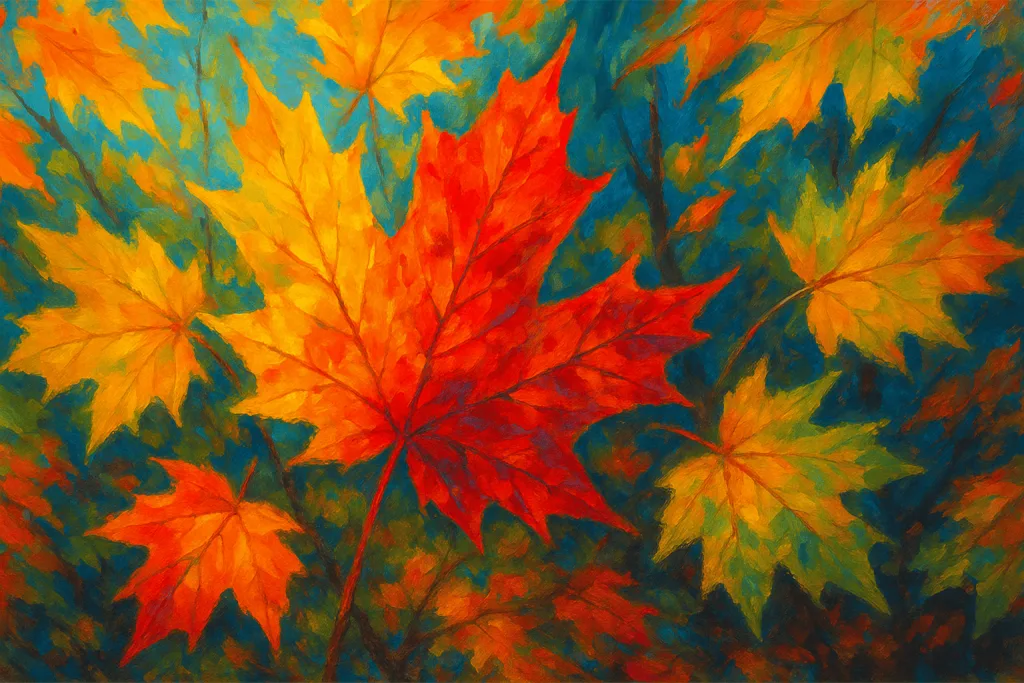
This seasonal change in color preoccupation mostly happens in October, and autumn is well underway. With it the leaves start showing warm colors of yellow and orange and red. However, you may wonder why this change happens and how it operates.
The color change in the leaves of deciduous trees happens during autumn, although not at the same time every year. The relative amounts of yellow and red colors can also differ quite a lot from year to year. So, what’s the most important influence on that? In two words: weather conditions.
Deciduous trees shut down photosynthesis when the days grow shorter and the rays from the sun begin to strike at a lower angle: an operation dependent on chlorophyll, the pigment giving the leaves the green color.
As soon as photosynthesis ceases, chlorophyll, along with other nutrients, breaks down and is withdrawn from the tree in a series of metabolic processes, which go on to pull back valuable nutrients into the tree.
And when the leaves fall, they no longer lose water from their vast surface area, which is crucial, since trees would struggle to replace that moisture in winter, when the soil is largely frozen.
Weather Fuels the Colors of Fall
Color development begins with temperature and soil moisture. A few consecutive cool nights enhance the breakdown of chlorophyll and also initiate the shift of colors from green to yellow or red.
Carotenoids are pigments that create the colors-yellow and orange. They remain in leaves throughout the growing season. Carotenoid colors are dominated by green chlorophyll, which only gives way to yellows and reds when chlorophyll fades.
In contrast, red and purple pigments known as anthocyanins are produced as a stress response in autumn, appearing for only a short duration to assist trees in recovering some nutrients from leaves before falling.
Weather also determines the degree of redness; too much sunshine could make it harder for trees to absorb nutrients from old leaves, producing a brilliant red.
Under the right conditions, like in the high-pressure weather system with loads of sun and cool nights that are not frosty-could lead to some spectacular displays of autumn color. Frost, on the other hand, halts anthocyanins’ production, which means no further red coloring. In this case, carotenoids would prevail, giving the leaves an overall yellow to orange appearance.
Drought during the growing season can trigger a tree to form a separation layer, or lamina, early, causing leaves to fall prematurely before they have an opportunity to change colors.
Another reason why leaves may drop prematurely before fully transitioning to autumn colors is rain or wind.
Whispers of the Seasons

You can experience the magnificent shift of the seasons in Whispers of Seasons, a slot that feels like a living painting. Every spin is a brushstroke across Japan’s timeless beauty — from cherry blossoms in spring to snow-dusted Mount Fuji in winter. It’s not just a slot; it’s an experience that moves and breathes with the seasons.
Here’s what makes this game truly special:
- Spring: Watch Sakura blossoms bloom as Respin Wilds and the Hold & Spin Coin Collector feature fill your screen with soft pink wins.
- Summer: Fireworks light up the night sky — Bursting Wilds and Free Games turn every spin into a colorful celebration.
- Autumn: The leaves may fall, but your wins rise with Multiplier Wilds and Jackpot Coins that unlock golden surprises.
- Winter: Calm, serene, and powerful — Expanding Mount Fuji Wilds bring peace and big potential with every snowfall.
And if you can’t choose just one season? Let the Random Season Mode decide your fate — a new atmosphere, a new Wild, and a new chance to win with every spin.
With its 25 paylines, beautiful soundtrack, and elegant hand-painted visuals, Whispers of Seasons is a journey through time, art, and fortune. The seasons are whispering… are you ready to listen?
When Does Autumn Really Start-and Phenology
Phenology is the scientific study of seasonal natural events-in plants and animals-and their connection to weather and climate.
In layman’s terms, it explains when things happen in nature. That has all to do with tracking when trees bud, flower, or change color; when birds migrate; when insects emerge; and when fruits or crops ripen.
Therefore, these phenological gardens act as ecosystems whereby scientists observe seasonal transitions in several plant species and subsequently determine climatic-change databases, as well as weather conditions and plant ecology.
For example, a phenological garden may record the beech tree’s first color change or strawberry bloom as an aide to track the beginning and end of a number of “phenological seasons.”
Typically, the start of “full autumn” is denoted by the commencement of color change in the beech tree. In Germany, this occurs around October 10, beginning from higher elevation areas. Late autumn, officially, begins approximately two weeks later, once when most leaves are down.
Why Conifers Stay Green
Conifers are trees that do not lose their green color in autumn and maintain this color in the fair season, save for larch trees. The reason behind this fact is the specific structures and functions of their special needles.
Their needles are adapted to retain chlorophyll and continue photosynthesis all year round, although at a very slow rate.
A thick waxy cover and resin content reduce the loss of water. Thus, conifers never withdraw nutrients akin to deciduous trees from their needles prior to winter.
On the other hand, the resin and waxes protect chlorophyll and other pigments from being damaged by icy wind and low temperature. Their needles also contain sugars and proteins that function as natural antifreeze to protect them from frost and to keep their foliage untouched.