
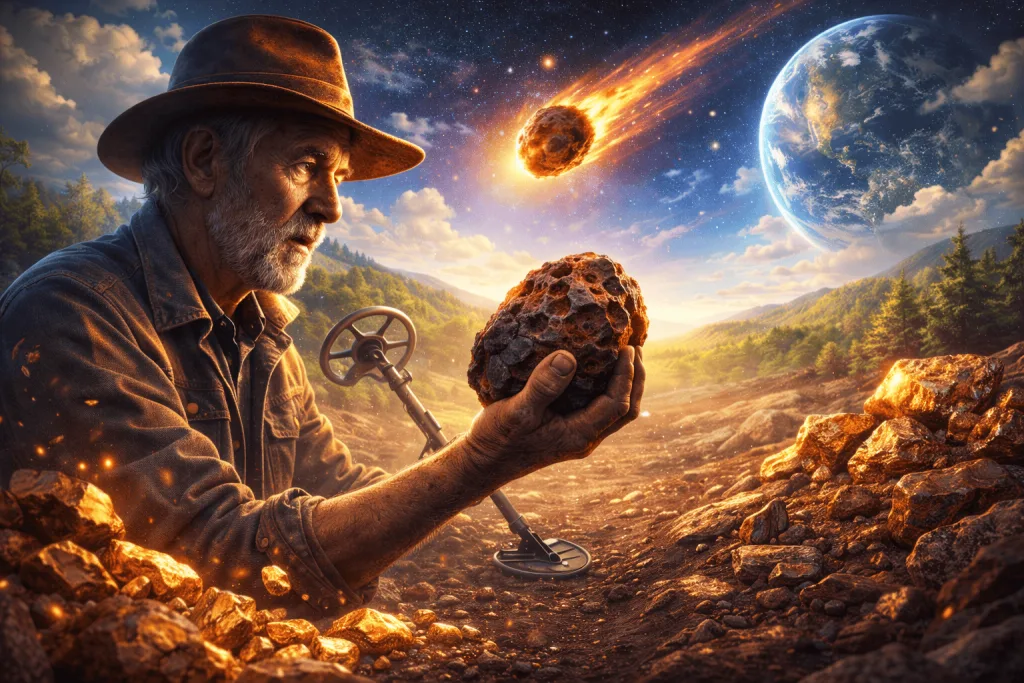
An extraordinary discovery may sometimes be made in pursuit of something unusual.
In 2015, the Australian had set out on a simple mission: look for gold. Instead, he stumbled upon a piece of cosmic history that was infinitely rarer and valuer than any gold nugget.
An Ordinary Day with an Unusual Turn
David Hole was scouring the Maryborough Regional Park in Victoria, Australia, with his hopes and a metal detector. This area is steeped in the history of Goldfields, where Australia’s gold rush reached its peak in the 19th century. For this reason, his expectations were not entirely unreasonable: thousands of gold nuggets have come out from its soil over the years.
After a signal from his detector, Hole dug out a heavy red rock. It didn’t appear like the sort of rock one associates with gold mineralization: on the one hand, it seemed too dense to leave behind, and on the other, it seemed too promising to let go. He had convinced himself that there must be gold within the rock.
That’s when things started to get weird.
He tried a number of ways to break it open with no success: hitting it with a hammer, trying heavier tools — nothing worked. The rock wouldn’t budge.
This Rock Just Wouldn’t Budge
Most rocks give way eventually to such pressure. This one didn’t.
Nevertheless, after a few more years of curiosity, Hole took the remaining piece into the Melbourne Museum for identification of this object. What he learned there changed the whole story.
That “rock” wasn’t really a rock.
It was a meteorite.
Paydirt

That idea of searching for gold and uncovering something even more exciting fits perfectly with Paydirt! Go for the Gold. Just like David Hole’s unexpected discovery, this game is all about digging beneath the surface and letting surprises reveal themselves. On the outside, it’s a classic Wild West gold-rush slot, but once the reels start spinning, it quickly shows that there’s much more hiding in the ground. With every spin, you’re chasing that moment where a simple dig turns into a real strike of fortune.
What makes Paydirt stand out:
- A 5×3 layout with 10 paylines that keeps the action fast and easy to follow
- Paydirt Wild Scatters that unlock Free Games and set the stage for big moments
- A Special Morphing Symbol chosen at random before Free Spins, capable of filling entire reels when it hits
- Free Games that can be retriggered, stacking more spins and more morphing power
- Medium volatility with a top award of up to 50,000× your bet per line
Paydirt is built around that classic thrill of discovery. You never quite know what’s waiting until you take another swing at the reels. Sometimes it’s a steady win, sometimes it’s a feature that transforms the whole screen, and sometimes it’s the kind of payout that makes the dig feel more than worth it.
They Knew Immediately
Dermot Henry, a geologist at Melbourne Museum, noticed something really interesting with this specimen: the sculpted, pitted surface was a definite signature from an object traveling through the Earth’s atmosphere with very high speed.
The melting of outer layers and shaping from intense heat and air pressure give meteorites a characteristic appearance that trained eyes cannot miss.
Henry remarked that out of the thousands he had examined over 37 years, only two had turned out to be real meteorites, and this was one of them.
Older Than the Earth Itself
The scientists later published their detailed studies about the object, naming it the Maryborough meteorite after the area from which it was recovered.
The findings were jaw-dropping.
The meteorite is said to be around 4.6 billion years old, nearly the age of the solar system itself. With a weight of 17 kilograms and a high iron concentration, it has gained classification as an H5 chondrite.
This type of meteorite is very precious for science since it contains information from the very beginning of planetary formation.
Why Meteorites Are of Greater Importance Than Gold
Gold is rare. This meteorite is far more rare.
Fewer than 17 meteorite falls have been officially recorded throughout the entire state of Victoria. It may be contrasted with thousands of the state lineage gold nuggets.
Meteorites provide something that gold can never give — a direct treatise on the origin of the solar system.
Some contain ancient stardust pre-dating the Sun; others have organic structures like amino acids, which constitute life’s fundamental building blocks. They give the scientists a way of understanding how planets form, how elements could be created, and even about how life may have begun.
A Journey Through Space
Researchers think that this Maryborough meteorite came from the area in the asteroid belt between Mars and Jupiter. Probably a collision set it free, to wander far in space until it strayed into Earth.
How long it lay buried remains uncertain, while the scientists estimate that it may have landed between 1000 and 100 years ago.
And there it waited for all those years without a wimp.
A Reminder to Look Twice
Gold was David Hole’s aim, and he found something far more extraordinary.
His tale serves as a reminder that not all treasures glimmer: some appear to be ordinary stones; some refuse to break; some turn out to be visitors from space.
Not a bad day of metal detection.
If for nothing else, it proves one point: the Earth still keeps on giving surprises-and some of them are mere infants in the range of billions of years old.